
Bitcoin x Ethereum: store of value versus business infrastructure

By Fabiano Dias
Bitcoin and Ethereum are usually treated as price rivals. In practice, they are projects with different theses. The first consolidated itself as a store of value and a monetary system of rare change. The second became the programmable base on which companies, developers, and the financial market build products. Whoever looks only at the chart misses the essential: where the business is born.
I have followed international payments in crypto since 2016, on the original Bitwage team — now part of Paystand, a B2B payments network that has already processed more than US$20 billion. I also work as an advisor and investing partner at LiberEther. That routine makes one thing plain: the money that circulates day to day — salary, supplier, treasury, contract — asks for programming, stablecoins, and applications. It does not ask only for scarcity.
Bitcoin Core is a reference client. About 40 active developers and five maintainers with the merge key sustain a slow, public, and conservative process. Brink, Chaincode Labs, and Spiral support the work. The result is stability. Soft forks are rare. The bar for changing the protocol is very high. For whoever wants digital gold, that is a virtue.
Ethereum does not have a single owner of the code. Several teams implement the same protocol: Geth, Nethermind, Besu, Erigon, and Reth on execution; Lighthouse, Prysm, Teku, Nimbus, and Lodestar on consensus. Coordination goes through the All Core Devs calls and the EIPs. The Ethereum Foundation researches and organizes. The Protocol Guild brings together about 190 to 196 contributors to the base protocol. The complexity is greater. So is the capacity to evolve.
It is this difference that the diagram makes clear.
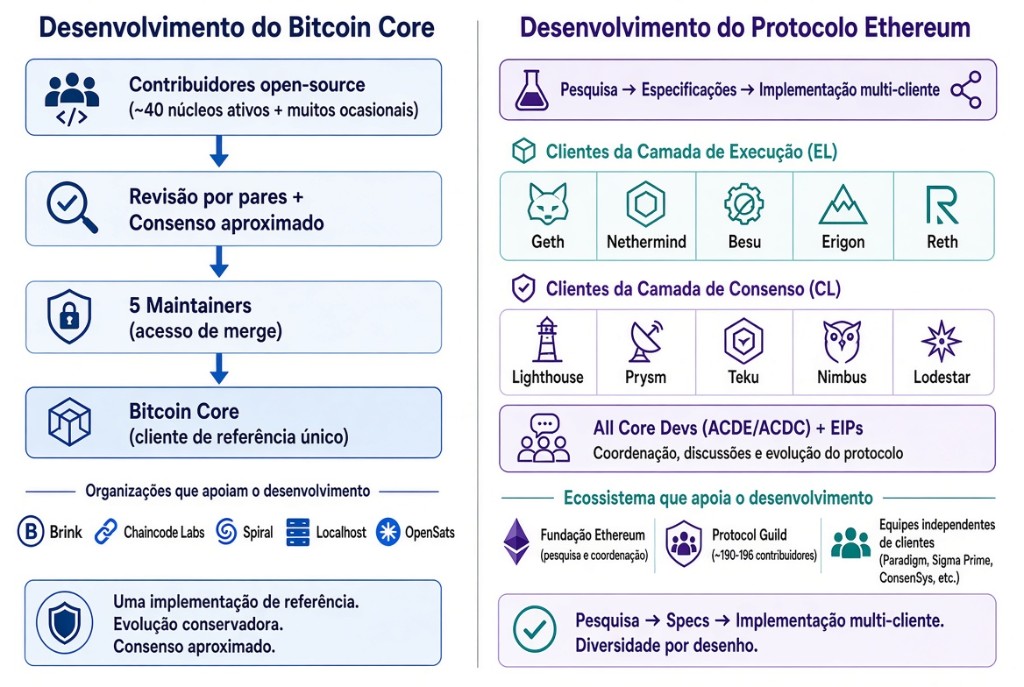
On the left, a straight line: contribute, review, merge, publish. On the right, research becomes a specification and then becomes several clients in production. Diversity of implementation is not a technical detail. It is what allows stablecoins, smart contracts, payroll, DeFi, and business settlement on the same rail.
At Bitwage, where I started in this sector in 2016, the difference was always not taking custody: the value goes to the wallet the user controls. Bitcoin fulfills that role as a sovereign asset. But the volume that grew in salary payments and in B2B was that of stablecoins — dollars on-chain, settlement in minutes, foreign exchange without the delay of the correspondent bank. The California payments company Paystand acquired Bitwage in November 2025 precisely to take this to corporate scale: global accounts payable, treasury, and suppliers. That kind of product lives better on a network that accepts programmable rules and iterates often.
Bitcoin wins on the criterion of conservative security and resistance to capture. Nobody should dismiss that. Ethereum wins on the criterion that the financial market and the business developer use every day: absolute capacity and ambition. More teams, more clients, more research, more capital in the protocol, and a pipeline that turns an idea into an upgrade.
For whoever builds technology or operates payments, the useful future is not the protocol that changes the least. It is the one that can change without breaking — and still deliver a new tool. In that frame, Ethereum is ahead.